
• Scottish prosecutors are seeking to interview Moussa Koussa, the Libyan foreign minister and former spy chief who defected to Britain, about the Lockerbie bombing. The request from Scotland's Crown Office comes as opposition rebels in Libya are demanding Koussa be returned to stand trial for murder and crimes against humanity.
• There have been unconfirmed reports that several more Gaddafi officials have defected in the wake of Koussa's flight to Britain. Al-Jazeera cited reports saying Mohammad Abu Al Qassim Al Zawi, a senior government figure, and leading oil official Shokri Ghanem had defected, however Reuters said Ghanem had denied the claim. Meanwhile, Ali Abdussalam Treki, appointed by Gaddafi as UN ambassador, refused to take up the post, condemning the "spilling of blood in Libya".
• In Washington, the Pentagon said it would shortly be pulling its fighter planes out of the allied air campaign over Libya, a move that would leave Britain and France at the helm. US senators questioned the timing of the announcement which came as government forces made significant advances on the rebels.
• In signs that turmoil is continuing to spread across the Middle East, Kuwait became the latest country in the region to see its government resign amid calls for political and economic reform. Meanwhile, the Foreign Office is urging all British citizens in Yemen to leave after a "rapid deterioration" in security after several weeks of protests.
If the handcuffs had been the hardest physical torment, this final interrogation was the toughest psychological assault.
For an hour and a half I struggled to build a rapport with my unseen interrogator, who opened proceedings with insults, threats and a couple of mild slaps, but eventually turned insincere "good cop" when he felt he had enough material for my "confession".

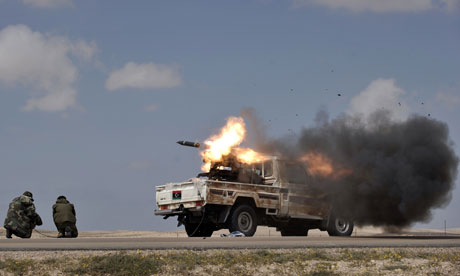
Photograph: Andrew Winning/Reuters
The rebels were regrouping on Friday in the hope of recapturing the oil town of Brega, to the west of Ajdabiya.An air of tense anticipation hangs over Syria this morning. Damascus is once again heavily policed by security forces; shops are usually shut on Friday mornings but some have been shuttered over the last few days. There is widespread anger at Assad's failure to announce reforms in his speech on Wednesday.
Gatherings are likely to be large in Deraa and Latakia, but other places to watch include Banias, Homs and the Damascus suburb of Douma. I'm hearing that Kurds may well also come out in the north-east governorate of Hassakeh. They have held back so far for fear of allowing the government to frame it as Kurdish unrest. The government is clearly rattled -- this morning its official news agency announced a commission had been set up to look into granting citizenship to thousands of Kurds who were stripped of it by a census in 1962.
Syria's network of information activists are reporting that protesters have started to gather in Deraa as well as towns in the north-eastern province of Al Hassakeh. This includes Qamischli, a Kurdish stronghold on the border with Turkey. Protests today have been dubbed the "Friday of Martyrs" in remembrance of over 100 people believed to have been killed in the last two weeks.
Opinions are sharp in Yemen. It's reached the stage now where you're either for or against the president. A few weeks ago there were a lot of people who were very indifferent to the whole thing, but now these two sides are both growing.
Finn says the anti-government protests have been peaceful so far, but there are growing calls within their camp to march against Saleh's supporters in the face of increasing defiance from the president.
He also made clear that Saif Gaddafi will be classed the same way as his father, saying "we have a very clear view about the present regime and those people involved in that regime". He also confirmed Moussa Koussa was in a secure location but refused to say where.
Activists and diplomatic sources say there are protests currently being held in the following places: Deraa, Latakia, Banias, Douma and the Kafersouseh area of Damascus in addition to the Kurdish north-east. Tear gas is reportedly being used to disperse people in Douma. There are also reports of pro-Assad rallies taking place in Damascus and beyond.
Worth adding that reports circulating that the government declared today a work day to avoid protests are untrue.
AFP earlier reported that a "rusting fishing trawler" had reached Misrata carrying food and medical supplies from Malta. It said the aid was provided by Libyan diaspora groups and international humanitarian agencies.
This suburb of Damascus is turning into a hot spot today. Several credible sources report that earlier security forces shut doors to mosques, including Damascus's Omayyad mosque, and allowed only small groups out at a time to prevent large crowds gathering.A witness told the news agency that at least six protesters were arrested and dozens where beaten as they made their way out of the mosque.
Meanwhile, Syria seems to have gone into overdrive in announcing moves to appease protesters. As well as the commission to look into Kurdish citizenship mentioned earlier, the state news agency SANA is reporting the establishment of two committees to look into the "incidents" in Deraa and Latakia. Mohamed Radwan, an Egyptian-American detained by the authorities has just been released according to tweets by family members.
The first videos of today's protests - which the Guardian is unable to independently verify - are posted on the Syria Revolution Facebook site.
Dr Suleiman Refardi said Wednesday's raid happened in the village of Zawia el Argobe, 15km (9 miles) from Brega.
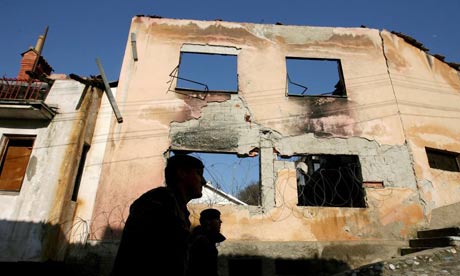
The strike hit a truck carrying ammunition, and the resulting explosion destroyed two nearby homes.
All the dead were between the ages of 12 and 20, Dr Refardi said. Nato says it is investigating the claim.

Photograph: Maurizio Gambarini/EPA
It was unclear if the rebel truce offer was part of any broader diplomatic effort to end the conflict now dragging into its second month despite international air strikes.
Two homes were said to have been destroyed when the strike hit a truck carrying ammunition. All the dead were between the ages of 12 and 20, he said.
Nato is investigating the claim.
The Americans, a Vermont college student studying Arabic in Syria and an engineer from Texas who had been working in the country, were arrested while taking photographs of demonstrations on March 18, according to Syrian state media.In an attempt to finally bring order to its chaotic military campaign, the rebel leadership introduced the first of newly trained troops toward Brega, which was seized by the government earlier this week, and hauled up rocket launchers.
They were also seen to have new radio and other communications equipment which the leadership was appealing to foreign governments to provide just a few days ago.
The newly uniformed soldiers included officers who, the rebels said, would establish firm lines of command in an attempt to end the shambolic confrontations in which the revolutionaries have only been able to move forward under the cover of western air strikes and have been unable to hold ground because they lack plans for defence.
The rebels began screening which of the ill-disciplined civilian volunteer fighters would be permitted to go toward the front line in order to stop the scenes of large numbers of them charging forward without order and then retreating en masse under fire.
The Syrian state news agency (SANA) is blaming "armed groups" for the shooting. Authorities have been using this formula of words for a while to describe the violence of recent weeks, which demonstators and others have blamed on the security forces themselves.
 @Arab_Spring, for one, isn't impressed:
The art of telling LIES: Syrian News Agency: armed groups open fire on Syrian citizens and security forces in Douma and Homs, killing a girl
"An official source said an armed group took to the rooftops of some buildings in Douma after midday and opened fire on hundreds of citizens gathering in the city and on security forces," said SANA
"In the city of Homs, an armed group opened fire on a gathering of citizens in the Bayyada district, which resulted in the death of a girl," it added.
It has more on the violence in in Douma, where a number of people have reportedly been killed:
An activist in Douma, just outside the capital, said he and hundreds of others came under attack by security forces as they left the town's Grand Mosque, chanting slogans for freedom.
He said the troops hit people with clubs and threw stones before firing tear gas and finally live ammunition.
"I saw three people dead and six wounded," the activist said. "Douma's streets are now totally empty except for security forces of whom some are in plainclothes."
Other protests took place in the southern city of Daraa, which has become the epicenter for the protests.
Several eyewitnesses told The Associated Press by telephone that up to 5,000 people were marching in Daraa, shouting "We want freedom!" and "The blood of martyrs is not cheap!"
• Scottish prosecutors are seeking to interview Moussa Koussa, the Libyan foreign minister and former spy chief who defected to Britain, about the Lockerbie bombing. The request from Scotland's Crown Office comes as opposition rebels in Libya are demanding Koussa be returned to stand trial for murder and crimes against humanity.
• Seven civilians were killed and 25 hurt in a coalition air strike on a pro-Gaddafi convoy yesterday, it was claimed today.
The claim was made by a doctor who spoke to the BBC from eastern Libya, where he said that the raid hit a truck carrying ammunition, and the resulting explosion destroyed two nearby homes in the village of Zawia el Argobe, 15km (9 miles) from Brega.
• There have been unconfirmed reports that several more Gaddafi officials have defected in the wake of Koussa's flight to Britain. Al-Jazeera cited reports saying Mohammad Abu Al Qassim Al Zawi, a senior government figure, and leading oil official Shokri Ghanem had defected, however Reuters said Ghanem had denied the claim. Meanwhile, Ali Abdussalam Treki, appointed by Gaddafi as UN ambassador, refused to take up the post, condemning the "spilling of blood in Libya".
• Security forces opened fire on demonstrators in Syria two days after President Bashar al-Assad delivered an uncompromising address aimed at restoring rigid order in a country that rarely witnesses dissent.
At least three people were killed and scores more injured as thousands protested across the nation on a day dubbed the "Friday of Martyrs".
• Yemen's president, Ali Abdullah Saleh, has signalled he has no plans to step down as huge rival demonstrations swept through the capital, Sana'a.
Saleh's display of defiance, in which he said he would sacrifice everything for his country, followed weeks of youth-led anti-government protests, as well as a string of defections by generals last week that analysts say had him on the brink of resignation.