Here's a summary.
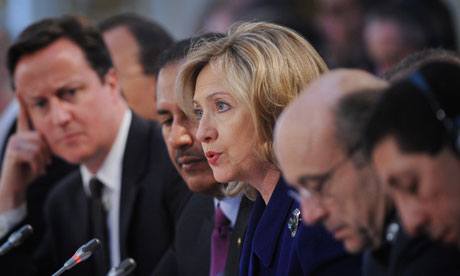
 The US secretary of state, Hillary Clinton, says military strikes on Libya will continue until its leader Muammar Gaddafi complies with the terms of UN resolution 1973. She was speaking at the opening of the London Conference on Libya, at which the British prime minister David Cameron said Gaddafi is still in "flagrant breach" of United Nations security council resolutions and is allowing civilians to bleed to death in the streets of Misrata.
The US ambassador to the UN refuses to rule out arming Libyan rebels. In an interview with ABC television, Susan Rice said: "We have not made that decision, but we've not certainly ruled that out."
The interim national council, formed by opposition groups in Libya, says it will hold free and fair elections and draft a national constitution. It has set out "a vision of a democratic Libya". They have just finished holding a press conference in central London.
Live blog: recap
The Syrian cabinet has resigned as regime seeks to calm protests. The move is the latest concession by President Bashar al-Assad after more than a week of mass protests calling for more political freedom. It will not affect Assad, who holds the lion's share of power in the regime.
Iman al-Obeidi, the Libyan woman who burst into a Tripoli hotel telling western reporters she had been raped by Gaddafi's militiamen, now faces criminal charges herself. Her whereabouts are still unknown but spokesman Mussa Ibrahim said that charges had now been brought against her by some of the men she had accused.
Gaddafi's forces have attacked rebel fighters east of the Libyan leader's home town of Sirte prompting a panicked, chaotic retreat. Reuters said Gaddafi's forces used a "hail of machinegun and rocket fire" to drive the rebels back.
 Shells explode around a column of rebel vehicles near Bin Jawad, Libya. Photograph: Finbarr O'reilly/Reuters
Reuters reports:
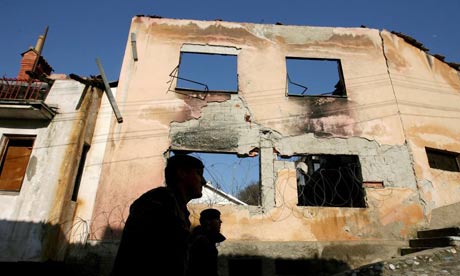 Nato peacekeepers patrol a town in Kosovo, 2008. Photograph: Valdrin Xhemaj/EPA Wired blogger Spencer Ackerman has comments by Admiral James Stavridis, Nato's supreme allied commander for Europe, at a Senate hearing in Washington:
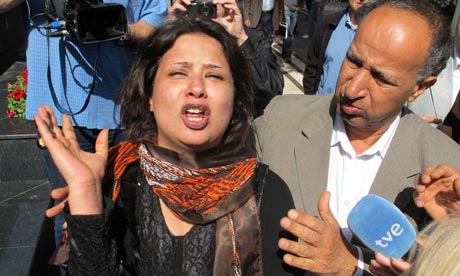 Iman al-Obeidi attempts to talk to journalists in Tripoli. Photograph: Mohamed Messara/EPA Speaking from Tobruk, Iman al-Obeidi's mother says she hasn't heard from her daughter for three days and is furious at how the regime has treated her.
The mother said she last talked with her daughter on Sunday, who was then being kept in some kind of regime compound.
• Barack Obama said in an interview that members of the Gaddafi regime were starting to recognise that "their days are numbered". He also described the opposition leaders that have met with US officials as "professionals, lawyers, doctors – people who appear to be credible"
• US, French and British leaders, along with Qatar, appear willing to supply arms to the rebel forces if the coalition's air strikes fail to dislodge Gaddafi's regime
• Admiral James Stavridis, Nato's supreme allied commander for Europe, told a US Senate hearing that the latest intelligence showed a "flicker" of al-Qaida or Hezbollah activity within the Libyan opposition but said there was not enough detail to be sure
• The coalition launched a further 22 Tomahawk missiles and flew 115 air strike sorties within the last 24 hours, the Pentagon revealed
• The mother of Iman al-Obeidi told CNN that she has not spoken to her daughter since Sunday, the day after she spoke out to journalists in Tripoli, and does not know where she is being held
The US secretary of state, Hillary Clinton, says military strikes on Libya will continue until its leader Muammar Gaddafi complies with the terms of UN resolution 1973. She was speaking at the opening of the London Conference on Libya, at which the British prime minister David Cameron said Gaddafi is still in "flagrant breach" of United Nations security council resolutions and is allowing civilians to bleed to death in the streets of Misrata.The US ambassador to the UN refuses to rule out arming Libyan rebels. In an interview with ABC television, Susan Rice said: "We have not made that decision, but we've not certainly ruled that out."
The interim national council, formed by opposition groups in Libya, says it will hold free and fair elections and draft a national constitution. It has set out "a vision of a democratic Libya". They have just finished holding a press conference in central London.
Live blog: recap
The Syrian cabinet has resigned as regime seeks to calm protests. The move is the latest concession by President Bashar al-Assad after more than a week of mass protests calling for more political freedom. It will not affect Assad, who holds the lion's share of power in the regime.
Iman al-Obeidi, the Libyan woman who burst into a Tripoli hotel telling western reporters she had been raped by Gaddafi's militiamen, now faces criminal charges herself. Her whereabouts are still unknown but spokesman Mussa Ibrahim said that charges had now been brought against her by some of the men she had accused.
Gaddafi's forces have attacked rebel fighters east of the Libyan leader's home town of Sirte prompting a panicked, chaotic retreat. Reuters said Gaddafi's forces used a "hail of machinegun and rocket fire" to drive the rebels back.
Shells explode around a column of rebel vehicles near Bin Jawad, Libya. Photograph: Finbarr O'reilly/Reuters Muammar Gaddafi's forces launched a powerful counter attack against Libyan rebels, sending the revolutionaries fleeing from towns they took only two days earlier. The government launched its assault in defence of the politically and strategically significant town of Sirte after the rebels moved to within 45 miles under the protection of western air strikes.But the US Secretary of State Hillary Clinton suggested that it would be legal to arm the rebels. She told a press conference at the Foreign Office: "It is our interpretation that [UN Security Council resolution] 1973 amended or overrode the absolute prohibition on arms to anyone in Libya, so that there could be a legitimate transfer of arms if a country should choose to do that."
Gaddafi's forces, bolstered by reinforcements sent to Sirte in recent days, launched a bombardment of the rebel positions with rockets and shells. Although the revolutionaries held their ground for a while around the town of Bin Jawad, they eventually broke and fled under the intense assault.
The government's army moved in to the town and then continued to press east for 20 miles or more on the main coastal road until they came within striking distance of Ras Lanuf. A fresh round of attacks on the road by Gaddafi's forces sent most of the rebels fleeing from the town which was left dangerously vulnerable.
Those two towns, along with others on the road to Benghazi, have changed hands several times since the beginning of the uprising two months ago.
Reuters reports:
"We are examining very closely the content, composition, the personalities, who are the leaders of these opposition forces," Admiral James Stavridis, NATO's supreme allied commander for Europe and also commander of US European Command, said during testimony at the US Senate.Clinton said "we don't know as much as we would like to know" about the opposition in Libya:
...
While Stavridis said the opposition's leadership appeared to be "responsible men and women" fighting Gaddafi, he said that "we have seen flickers in the intelligence of potential al-Qaida, Hezbollah. We've seen different things."
"But at this point I don't have detail sufficient to say there is a significant al-Qaida presence or any other terrorist presence," he said.
The Pentagon says it is not communicating officially with the Libyan rebels.
US Ambassador to the United Nations Susan Rice disagreed that al-Qaida was involved in the rebel movement.
"I would like to think I'm reading much of the same stuff and no," Rice told Fox News when asked whether she had seen any evidence to support Stavridis' assessment.
"I think we can't rule out the possibility that extremist elements could filter into any segment of Libyan society and it's something clearly we will watch carefully for," she added.
We're building an understanding, but at this time obviously it is, as I say, a work in progress.
We have to evaluate the airstrikes after a while to see if it's effective. We are not inviting any military ground [forces] ... but we have to evaluate the situation because we cannot let the people suffer for so long, you know. We have to find a way to stop this bloodshed.
Nato peacekeepers patrol a town in Kosovo, 2008. Photograph: Valdrin Xhemaj/EPA During a Senate hearing on Tuesday, Sen Jack Reed of Rhode Island asked Adm James Stavridis about Nato putting forces into "post-Gadhafi" Libya to make sure the country doesn't fall apart. Stavridis said he "wouldn't say Nato's considering it yet." But because of Nato's history of putting peacekeepers in the Balkans – as pictured above – "the possibility of a stabilization regime exists."
Iman al-Obeidi attempts to talk to journalists in Tripoli. Photograph: Mohamed Messara/EPA The mother said she last talked with her daughter on Sunday, who was then being kept in some kind of regime compound.
Libya's rebels are not the anti-Western militants Muammar Gaddafi says they are, but worsening turmoil and killings of civilians by the West would help al Qaeda get a foothold, according to a British think tank.Meanwhile, CNN reports on the "carnage" within the embattled western city of Misrata.
Quilliam, a group that studies Islamists, said in a report that while Libya had jihadist groups, "they are nowhere near as powerful or as widespread as the Gaddafi regime has claimed".
"That said, the breakdown in Libyan government control over much of Libya, combined with the ongoing fighting in many parts of the country, clearly gives jihadists and extreme Islamists more scope than ever before to operate in Libya," it said.
It also said the amount of weapons becoming available in Libya as a result of the war was a serious cause for concern.
Eyewitness says residents of al-brega fleeing east after Libyan army regains control of ras lanuf. #Libya benwedeman
bencnn
benwedemanbencnn
At the end of a conference on Libya in London, Hillary Clinton, the US secretary of state, said for the first time that she believed arming rebel groups was legal under UN security council resolution 1973, passed two weeks ago, which also provided the legal justification for air strikes.
America's envoy to the UN, Susan Rice, said earlier the US had "not ruled out" channelling arms to the rebels.
The British foreign secretary, William Hague, agreed that the resolution made it legal "to give people aid in order to defend themselves in particular circumstances".
The west's main Arab ally, Qatar, also said providing weapons to Gaddafi's opponents should be considered if air strikes failed to dislodge him. The Gulf state's prime minister, Sheikh Hamad Al-Thani, said the effect of air strikes would have to be evaluated in a few days, but added: "We cannot let the people suffer for too long."
Due to technical problems we were unable to update this live blog, and it is now being closed. Here's a summary of the latest developments involving Libya:
• The latest reports suggest that pro-Gaddafi forces are fighting back and may have recaptured the town of Bin Jawad, with the lightly-armed rebels retreating back towards the towns of Brega and Ras Lanuf. In the west, the city of Misrata remains under heavy siege from Gaddafi's forces• Barack Obama said in an interview that members of the Gaddafi regime were starting to recognise that "their days are numbered". He also described the opposition leaders that have met with US officials as "professionals, lawyers, doctors – people who appear to be credible"
• US, French and British leaders, along with Qatar, appear willing to supply arms to the rebel forces if the coalition's air strikes fail to dislodge Gaddafi's regime
• Admiral James Stavridis, Nato's supreme allied commander for Europe, told a US Senate hearing that the latest intelligence showed a "flicker" of al-Qaida or Hezbollah activity within the Libyan opposition but said there was not enough detail to be sure
• The coalition launched a further 22 Tomahawk missiles and flew 115 air strike sorties within the last 24 hours, the Pentagon revealed
• The mother of Iman al-Obeidi told CNN that she has not spoken to her daughter since Sunday, the day after she spoke out to journalists in Tripoli, and does not know where she is being held

No comments:
Post a Comment