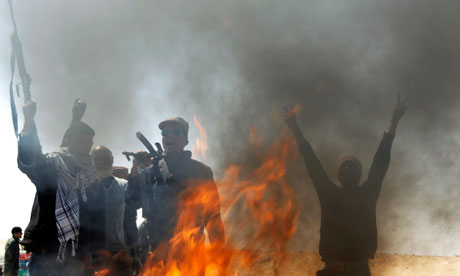
Ian Traynor and Nicholas Watt have the details of the deal. Here's a flavour.
"The Tornado aircraft launched a number of guided Brimstone missiles at Libyan armoured vehicles which were threatening the civilian population of Ajdabiya. Brimstone is a high precision, low collateral damage weapon optimised against demanding and mobile targets," said Fox.
Sheik Abdullah bin Zayed Al Nahyan says the UAE committed six F-16s and six Mirage aircraft to "participate in the patrols" over Libya. His comments were published by the state-run Wam news agency on Friday. Qatar, which has sent two planes, is expected to start flying air patrols by this weekend.
 Photograph: Filippo Monteforte/AFP/Getty Images

 Photograph: Hasan Jamali/AP
 Photograph: Muhammed Muheisen/AP
"I doubt that it will be days," Admiral Edouard Guillaud, the head of French armed forces, told France Info radio. "I think it will be weeks. I hope it will not take months."
"Another twin set of demos have seen hundreds of thousands of anti-government protesters gather outside of the university and a similar number of pro government protesters elsewhere. The president for the first time gave a speech to protesters and reiterated his intention to give up power, but he didn't say when or to who."

Al-Shurouk, Egpytian newspaper
Al-Sherq al-Awssat, Saudi newspaper based in London
Al-Itihad, UAE newspaper based in Dubai
 US authorities say that the coalition fired 16 Tomahawk cruise missiles and flew 153 air sorties in the past 24 hours. A Nato official said that the no-fly operation is set to run for 90 days, although this could be extended or shortened. The UAE has decided to send war planes to help enforce the no-fly zone.
President Saleh of Yemen has said on national television that he is willing to hand over power, but did not specify when or to whom. Separate demonstrations both for and against the government have been held in different parts of the city.
Syrian troops opened fire on protesters in the southern city of Deraa. Witnesses said there were several casualties. In Damascus, supporters of the Deraa protesters clashed with backers of the regime outside the historic Umayyad mosque.
Security forces in Bahrain quickly snuffed out small protests in Manama. In the village of al-Dair, police tear gas to disperse around 100 protesters who had marched toward a main road next to a runway at Bahrain international airport.
The US, Britain, France and Turkey agreed to put the three-pronged offensive – a no-fly zone, an arms embargo, and air strikes – under a Nato command umbrella, in a climbdown by France that accommodates strong Turkish complaints about the scope and control of the campaign.The British defence secretary, Liam Fox, says British Tornado GR4 aircraft launched a number of guided missiles at Libyan armoured vehicles.
The deal appeared to end days of infighting among western allies, but needed to be blessed by all 28 Nato member states. At the end of a four-day meeting of Nato ambassadors in Brussels, Anders Fogh Rasmussen, the secretary general, said Nato had agreed to take command of the no-fly zone from the Americans. Disputes have raged at Nato HQ every day this week. Rasmussen contradicted leading western officials by announcing that Nato's authority was limited to commanding the no-fly zone, but he signalled there was more negotiation to come.
Under the scheme agreed, the transfer to Nato will take place by the latest in London on Tuesday, when the parties to the coalition against Gaddafi gather in London for a special "contact group" conference. French sources said the Benghazi-based Libyan rebel leadership would be in London to attend. The conference will consist of two meetings: a war council made up of the main governments taking part in the military action, as well as a broader assembly including Arab and African countries devoted to Libya's future.
"The Tornado aircraft launched a number of guided Brimstone missiles at Libyan armoured vehicles which were threatening the civilian population of Ajdabiya. Brimstone is a high precision, low collateral damage weapon optimised against demanding and mobile targets," said Fox.
Mr Saleh and Gen Ahmar were intent on preventing bloodshed and preserving stability, the people familiar with the negotiations said. Aides to both men said they understood that Mr. Saleh's continued rule is untenable. But the two men also agreed that his resignation can't happen until the details of a transitional governing council that would take his place.
"Wefaq affirms the need to protect safety and lives and not to give the killers the opportunity to shed blood," it said on Thursday.
Nine demonstrations appear to be planned, across different parts of Bahrain, including one headed toward the airport and one that aims to "liberate" Salmaniya hospital. Security forces raided Salmaniya hospital in the crackdown, removing several tents set up by protesters in previous weeks. Doctors and human rights groups say strict security has hampered medical access and that four medical staff have been arrested.
"After the horrific killing of dozens of protesters last Friday, it is incredibly disturbing that Yemen's leaders have given the security forces more powers through a new emergency law instead of reining them in," said Philip Luther, Amnesty's Middle East and North Africa deputy director. "The emergency law appears to be a desperate attempt to reinforce mechanisms to stamp out dissent and shut out witnesses to human rights abuses."Amnesty has also called for an immediate halt to the use of "excessive force" by Syrian security forces after reports that more than 100 were killed in protests in the southern city of Deraa on Wednesday. Katherine Marsh (a pseudonym) reported on public outrage over the government's brutal response in today's Guardian.
Sheik Abdullah bin Zayed Al Nahyan says the UAE committed six F-16s and six Mirage aircraft to "participate in the patrols" over Libya. His comments were published by the state-run Wam news agency on Friday. Qatar, which has sent two planes, is expected to start flying air patrols by this weekend.
Messages seeking some kind of peaceful end to UN-backed military action or a safe exit for members of Gaddafi's entourage have been sent via intermediaries in Austria, Britain and France, said Roger Tamraz, a Middle Eastern businessman with long experience conducting deals with the Libyan regime.
At the UN, envoys said Sudan had quietly granted permission to use its airspace to nations enforcing the no-fly zone. Sudan's UN ambassador, Daffa-Alla Elhag Ali Osman, neither confirmed nor denied that report.
South of the Sahara, local media quoted a cabinet minister as saying Uganda would freeze Libyan assets worth about $375m in line with a UN resolution imposing sanctions on Libya following Gaddafi's violence crackdown.
Photograph: Filippo Monteforte/AFP/Getty Images "We don't want power, but we need to hand power over to safe hands, not to sick, resentful or corrupt hands ... We are ready to leave power but only for safe hands," Saleh said in the speech shown on state TV, as tens of thousands of his opponents protested in another part of the capital. "We are against firing a single bullet and when we give concessions this is to ensure there is no bloodshed. We will remain steadfast and challenge them with all power we have."
"As you can see, everything is back to normal and it is over," an army major, standing in front of the ruling Baath party head office in Daraa, told journalists before they were escorted out of the city.
African Union commission chairman Jean Ping said in an opening speech that the AU favours an inclusive transitional period that would lead to democratic elections. Ping stressed the inevitability of political reforms in Libya, and said that he believes a consensus can be reached. He called the aspirations of the Libyan people "legitimate."
"We are convinced that there is enough base to reach a consensus and find a durable solution in Libya," he said.
Damascus's streets were quiet as this morning, as they usually are before Friday prayers. However, there is a increased sense of tension - as well as plain clothed security agents who have been a feature of the streets for the week.
Big protests have been called for today across the country. I have not yet witnessed any but half an hour ago, groups of pro-Assad supporters - a feature of the past few days - drove round Damascus waving flags and photographs of the president.
After the pledges to consider reform made by the government early yesterday evening, Syrians across the country were at home last night processing what they meant and whether it changes the game today. "I do not think it will be enough; anger rose at the killings in Deraa and these announcements - which didn't offer anything solid - may have only added to that," said one man late last night.
Photograph: Hasan Jamali/AP Libyan government minders took a bus load of journalists to Tajura east of Tripli today where we saw a house in a rural area with a big garden. There was apparent damage caused by a missile which had landed in the garden. There were fragments of a US air-to-surface missile. A window and some furniture had been broken. According to the father, his 18-year-old daughter was injured and taken to hospital. What was difficult to understand was the link between the rocket fragments and the damage, there were also bullet holes on the wall. The general feeling was that something certainly had happened and it was an effort to underline how civilians have been victims of "colonial aggression". Surprisingly, however, we have not been taken to any hospitals. I don't doubt there have been some civilians casualties with thousands of missiles fired, but there has been no evidence of deaths to civilians on a large scale. We spent a good hour at the house but we sped by a building at a military installation that had been flattened by a missile and a radar installation on a sand dune that was completely destroyed, now a charred hulk. But there was not a word on that.
The UAE's decision to contribute 12 planes to the no fly zone operation is evidence of the real and tangible Arab role, building on the leadership the Arab League as a whole showed when they originally led calls for a no fly zone over Libya.
The troops started shooting on the crowds after they set fire to a bronze statue of the country's late president, according to a resident on the scene.
Tens of thousands of Syrians were taking to the streets across the country in the most widespread civil unrest in years, defying crowds of government backers and baton-wielding security forces to shout their support of the uprising in Daraa, according to witnesses, activists and footage posted online.
Thousands flooded Deraa's central Assad Square, many from nearby villages, chanting "Freedom! Freedom!" and waving Syrian flags and olive branches, a resident told The Associated Press by telephone.
Photograph: Muhammed Muheisen/AP Helicopters buzzing overhead, extra checkpoints erected on major highways and a large troop presence prevented any major demonstration from kicking off in the small Gulf Arab island kingdom.Meanwhile a Nato official in Brussels said planning for Nato's no-fly operation assumed a mission lasting 90 days, although this could be extended or shortened as required. France said the war could drag on for weeks.
A few hundred protesters managed a short rally in the Shia village of Diraz, shouting "down with the regime" as women swathed in black waved Bahraini flags and held up copies of the Quran. But they fled when when around 100 riot police fired tear gas and tried to chase them down.
In the village of al-Dair, police fired rounds of tear gas to disperse around 100 protesters who had marched toward a main road next to a runway at Bahrain international airport.
Residents in nearby streets rushed women and children into their house as police continued to loose tear gas. They said police had also fired birdshot ammunition at protesters.
"I doubt that it will be days," Admiral Edouard Guillaud, the head of French armed forces, told France Info radio. "I think it will be weeks. I hope it will not take months."
"Another twin set of demos have seen hundreds of thousands of anti-government protesters gather outside of the university and a similar number of pro government protesters elsewhere. The president for the first time gave a speech to protesters and reiterated his intention to give up power, but he didn't say when or to who."
Photograph: Muhammed Muheisen/AP
A Qatar air force Mirage 2000-5 flew alongside a French Mirage 2000-5 fighter jet in a patrol Friday over Libyan airspace, the military said in a statement.
Qatar has deployed six Mirage fighters (rather than the two we mentioned earlier) and two C-17 transport jets to support the operation.
Yemen president held meetings in past 48 hours with top army general who has defected to protesters AlArabiya English
AlArabiya_Eng
AlArabiya EnglishAlArabiya_Eng
Al-Shurouk, Egpytian newspaper
We know that the western states are interfering in Libya only out of fear on oil supplies and to keep prices stable. The proof is to compare Libya's case to Yemen.
The two presidents are not wanted but cling to power. They both used weapons against their people. But the western states were so upset with Libya and decided to bomb Gaddafi's military targets to topple his regime while no one cares about what the Yemeni president is doing although he killed more than 50 of his people by using snipers and hand grenades.
It is very clear Libya means oil for the west, Yemen does not mean that much.
Al-Sherq al-Awssat, Saudi newspaper based in London
The US administration which did not hesitate in demanding Gaddafi's dismissal, is not ready to force him to leave through a military campaign as it did with Saddam Hussein.
Gaddafi knows that American and European public opinion are not prepared for western forces to be sent to Libya or any Arab country after the experience in Iraq and Afghanistan and he is capable with his military and money to stand up to air strikes and sanctions.
The rebels might be able to keep control of Benghazi and the eastern part of the country but they can't enter Tripoli without foreign military support or a military coup.
Al-Itihad, UAE newspaper based in Dubai
Obama hopes that Gaddafi's forces will be defeated quickly, opening the way for a political solution. The hope is that Libya will get a new president or Gaddafi will be forced to leave the country, but what will happen if this is not achieved? What will happen if Gaddafi keeps fighting and uses his money to recruit mercenaries?
Without sending infantry troops, there will be no quick end to this war. The Libyan rebels would be in charge of the mission to end the war, but the problem is we do not know who these rebels are?
President Saleh of Yemen has said on national television that he is willing to hand over power, but did not specify when or to whom. Separate demonstrations both for and against the government have been held in different parts of the city.
Syrian troops opened fire on protesters in the southern city of Deraa. Witnesses said there were several casualties. In Damascus, supporters of the Deraa protesters clashed with backers of the regime outside the historic Umayyad mosque.
Security forces in Bahrain quickly snuffed out small protests in Manama. In the village of al-Dair, police tear gas to disperse around 100 protesters who had marched toward a main road next to a runway at Bahrain international airport.

No comments:
Post a Comment