Wednesday, March 30, 2011

India keep alive a billion dreams

India's Munaf Patel (2nd R) is congratulated by teammates including Virender Sehwag (R) after taking the wicket of Pakistan's Abdul Razzaq (L) during their ICC Cricket World Cup 2011 semi-final match in Mohali March 30, 2011. REUTERS/Adnan Abidi
By Amlan Chakraborty, Reuters
MOHALI, India (Reuters) - India kept alive a billion dreams after sinking Pakistan in their World Cup semi-final on Wednesday to set up an all-Asian final against Sri Lanka.s.

Sehwag, however, took it all in his stride as he blasted 21 runs off an Umar Gul over, a shock the Pakistani pace spearhead could not recover from in the remainder of the match.

India, however, could not make the most of the start and Wahab Riaz's maiden five-wicket haul restricted them to a total that would not have been possible but for Suresh Raina's unbeaten 36-run cameo down the order.

Pakistan were off to a decent start too but while the likes of Mohammad Hafeez (43) and Asad Shadiq (30) got the starts, they could not convert it into big knocks.

Down the order, Misbah (56) came out with some lusty hits but lack of partnerships meant by then the game had slipped through Pakistan's fingers, just like one of those catches from Tendulkar that went begging.

"Lack of partnerships has been a problem for us right from the start of the tournament and it recurred today," Afridi rued after Pakistan once again succumbed to the jinx of never beating their arch-rivals in one-day cricket's biggest stage.

"We have invariably won matches where we had partnerships. Besides, our shot selection was very poor."

(Editing by Pritha Sarkar)

Libyan rebels scatter, world mulls sending arms

The Arleigh Burke-class guided-missile destroyer USS Barry launches a Tomahawk cruise missile, as it sails the Mediterrenean Sea on March 29 to support Joint Task Force Odyssey Dawn. Loyalist forces overran the Libyan towns of Ras Lanuf, Uqayla and Brega, scattering outgunned rebels as world powers mulled arming the rag-tag fighters seeking to oust Moamer Kadhafi. (AFP/HO/Jonathan Sunderman)
By Marc Burleigh, AFP
AJDABIYA, Libya (AFP) - Loyalist forces overran the Libyan towns of Ras Lanuf, Uqayla and Brega on Wednesday, scattering outgunned rebels as world powers mulled arming the rag-tag fighters seeking to oust Moamer Kadhafi.

AFP reporters and rebel fighters said Kadhafi's troops swept through the oil town of Ras Lanuf, 300 kilometres (185 miles) east of Kadhafi's hometown Sirte, soon after dawn, blazing away with tanks and heavy artillery fire.

Panicked rebels called for coalition air strikes on Kadhafi's forces as they fled in their hundreds eastwards through Uqayla, where they briefly regrouped, then on to Brega, where they also halted temporarily before charging to the main city of Ajdabiya, 120 kilometres away.

"We want two things: that the planes drop bombs on Kadhafi's tanks and heavy artillery; and that they (the West) give us weapons so we can fight," rebel fighter Yunes Abdelghaim told AFP.

The 27-year-old, who was holding a Russian AK-47 assault rifle and French flag, said it seemed as if the coalition had halted its air strikes for two days coinciding with a London conference on the Libyan crisis.

"We want the French to bomb the (Kadhafi) soldiers," said another fighter, Ali Atia al-Faturi, as the sound of shelling and gunfire grew louder.

By nightfall, the town of Brega, which also has an oil refinery, was in the hands of loyalists, rebels said, and the sound of artillery fire could be heard on the outskirts of Ajdabiya.

Angry mumblings against French President Nicolas Sarkozy, hitherto seen as the rebel's principal protector, were heard.

"Why aren't they bombing? We've heard things like Sarkozy is backing out of this situation," said Abdullah Shwahdi, a 25-year-old fighter.

On Tuesday the rebels came within 100 km of Sirte before encountering fierce resistance which reversed an advance launched when Britain, France and the United States started UN-mandated air strikes on March 19.

The ceding of almost all the flat, arid terrain the rebels had taken control of just five days ago was an unplanned, almost panicky affair.

Talk by the rebel Transitional National Council in its Benghazi stronghold of a "tactical retreat" was clearly hollow. The insurgents -- most of them overconfident young men with no military training or discipline whatsoever -- know nothing of tactics.

As the insurgents were being routed, British Prime Minister David Cameron said in London the option of arming the rebellion had not been ruled out.

Asked in parliament what Britain's policy was on arming the rebels, given the existence of a United Nations arms embargo on Libya, Cameron replied: "We do not rule it out but we have not taken the decision to do so."

French Foreign Minister Alain Juppe had set the tone at a London conference on Tuesday when he said France is prepared to hold discussions on delivering arms to the rebels.

Russian Foreign Minister Sergei Lavrov said however Moscow believed that foreign powers did not have the right to do this under the mandate approved by the UN Security Council.

Belgium, too, voiced its opposition to sending arms to Libya, warning that the move could alienate Arab nations.

And in Beijing, China's President Hu Jintao warned French President Nicolas Sarkozy that air strikes on Libya could violate the "original intention" of the UN resolution authorising them if civilians suffer.

US Secretary of State Hillary Clinton said that although UN sanctions prohibit the delivery of arms to Libya, the ban no longer applies.

"It is our interpretation that (UN Security Council resolution) 1973 amended or overrode the absolute prohibition on arms to anyone in Libya, so that there could be a legitimate transfer of arms if a country should choose to do that," she said.

A spokesman for the rebel Transitional National Council, Mustafa Ghuriani, told reporters in the Benghazi "it would be naive to think we are not arming ourselves" to match the weaponry deployed by Kadhafi loyalists.

But he declined to confirm or deny that France and the United States were offering to supply arms, saying only that unspecified "friendly nations" were backing the rebels.

NATO's top commander revealed that there was no alliance representative on the ground in Libya to work with rebel forces and that he had no orders to supply the opposition with weapons.

Admiral James Stavridis also said the alliance was working to get a clearer picture of the opposition, amid intelligence reports showing "flickers" of a possible Al-Qaeda presence.

US President Barack Obama, who has laid out a moral imperative for protecting Libyan civilians caught in the battle, also said he did not rule out arming the rebels.

"I'm not ruling it out. But I'm also not ruling it in. We're still making an assessment partly about what Kadhafi's forces are going to be doing," Obama said.

Obama said the "noose" was tightening around the Libyan strongman, but noted that Kadhafi did not appear to be seeking to negotiate an exit from Libya yet, despite the bombardment of his forces.

But he added he believed Kadhafi would eventually quit.

"Our expectation is that as we continue to apply steady pressure, not only militarily but also through these other means, that Kadhafi will ultimately step down," he said.

Opening the London talks, Cameron said the air strikes were helping to protect civilians from "murderous attacks" by Kadhafi's forces especially in the western rebel-held town of Misrata.

"Kadhafi is using snipers to shoot them down and let them bleed to death in the street," Cameron told the conference.

A rebel spokesman reached by telephone in Misrata said Libya's third city, 214 kilometres (132 miles) east of Tripoli, had been blasted on Wednesday again by Kadhafi's forces, while a medic said 18 people were killed in fighting the previous day.

Tuesday, March 29, 2011

Libya crisis – live updates

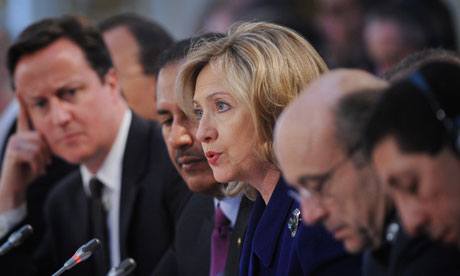
Hillary Clinton speaks as David Cameron listens during the London Conference on Libya
Hillary Clinton speaks and David Cameron listens during the London Conference on Libya. Photograph: Getty Images
Here's a summary.
Live blog: recap The US secretary of state, Hillary Clinton, says military strikes on Libya will continue until its leader Muammar Gaddafi complies with the terms of UN resolution 1973. She was speaking at the opening of the London Conference on Libya, at which the British prime minister David Cameron said Gaddafi is still in "flagrant breach" of United Nations security council resolutions and is allowing civilians to bleed to death in the streets of Misrata.
The US ambassador to the UN refuses to rule out arming Libyan rebels. In an interview with ABC television, Susan Rice said: "We have not made that decision, but we've not certainly ruled that out."
The interim national council, formed by opposition groups in Libya, says it will hold free and fair elections and draft a national constitution. It has set out "a vision of a democratic Libya". They have just finished holding a press conference in central London.
Live blog: recap
The Syrian cabinet has resigned as regime seeks to calm protests. The move is the latest concession by President Bashar al-Assad after more than a week of mass protests calling for more political freedom. It will not affect Assad, who holds the lion's share of power in the regime.
Iman al-Obeidi, the Libyan woman who burst into a Tripoli hotel telling western reporters she had been raped by Gaddafi's militiamen, now faces criminal charges herself. Her whereabouts are still unknown but spokesman Mussa Ibrahim said that charges had now been brought against her by some of the men she had accused.
Gaddafi's forces have attacked rebel fighters east of the Libyan leader's home town of Sirte prompting a panicked, chaotic retreat. Reuters said Gaddafi's forces used a "hail of machinegun and rocket fire" to drive the rebels back.
Shells explode around a column of rebel vehicles near Bin Jawad, Libya Shells explode around a column of rebel vehicles near Bin Jawad, Libya. Photograph: Finbarr O'reilly/Reuters
Muammar Gaddafi's forces launched a powerful counter attack against Libyan rebels, sending the revolutionaries fleeing from towns they took only two days earlier. The government launched its assault in defence of the politically and strategically significant town of Sirte after the rebels moved to within 45 miles under the protection of western air strikes.
Gaddafi's forces, bolstered by reinforcements sent to Sirte in recent days, launched a bombardment of the rebel positions with rockets and shells. Although the revolutionaries held their ground for a while around the town of Bin Jawad, they eventually broke and fled under the intense assault.
The government's army moved in to the town and then continued to press east for 20 miles or more on the main coastal road until they came within striking distance of Ras Lanuf. A fresh round of attacks on the road by Gaddafi's forces sent most of the rebels fleeing from the town which was left dangerously vulnerable.
Those two towns, along with others on the road to Benghazi, have changed hands several times since the beginning of the uprising two months ago.
But the US Secretary of State Hillary Clinton suggested that it would be legal to arm the rebels. She told a press conference at the Foreign Office: "It is our interpretation that [UN Security Council resolution] 1973 amended or overrode the absolute prohibition on arms to anyone in Libya, so that there could be a legitimate transfer of arms if a country should choose to do that."
Reuters reports:
"We are examining very closely the content, composition, the personalities, who are the leaders of these opposition forces," Admiral James Stavridis, NATO's supreme allied commander for Europe and also commander of US European Command, said during testimony at the US Senate.
...
While Stavridis said the opposition's leadership appeared to be "responsible men and women" fighting Gaddafi, he said that "we have seen flickers in the intelligence of potential al-Qaida, Hezbollah. We've seen different things."
"But at this point I don't have detail sufficient to say there is a significant al-Qaida presence or any other terrorist presence," he said.
The Pentagon says it is not communicating officially with the Libyan rebels.
US Ambassador to the United Nations Susan Rice disagreed that al-Qaida was involved in the rebel movement.
"I would like to think I'm reading much of the same stuff and no," Rice told Fox News when asked whether she had seen any evidence to support Stavridis' assessment.
"I think we can't rule out the possibility that extremist elements could filter into any segment of Libyan society and it's something clearly we will watch carefully for," she added.
Clinton said "we don't know as much as we would like to know" about the opposition in Libya:
We're building an understanding, but at this time obviously it is, as I say, a work in progress.
We have to evaluate the airstrikes after a while to see if it's effective. We are not inviting any military ground [forces] ... but we have to evaluate the situation because we cannot let the people suffer for so long, you know. We have to find a way to stop this bloodshed.
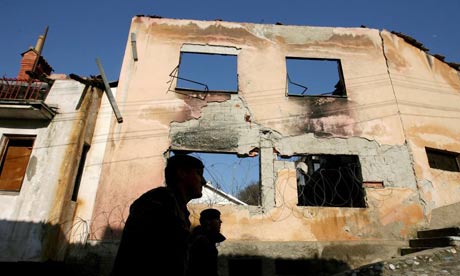
Nato peacekeepers in Prizren, Kosovo Nato peacekeepers patrol a town in Kosovo, 2008. Photograph: Valdrin Xhemaj/EPA
Wired blogger Spencer Ackerman has comments by Admiral James Stavridis, Nato's supreme allied commander for Europe, at a Senate hearing in Washington:
During a Senate hearing on Tuesday, Sen Jack Reed of Rhode Island asked Adm James Stavridis about Nato putting forces into "post-Gadhafi" Libya to make sure the country doesn't fall apart. Stavridis said he "wouldn't say Nato's considering it yet." But because of Nato's history of putting peacekeepers in the Balkans – as pictured above – "the possibility of a stabilization regime exists."
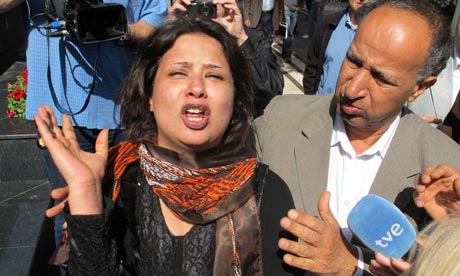
Iman Al Odeidi Iman al-Obeidi attempts to talk to journalists in Tripoli. Photograph: Mohamed Messara/EPA
Speaking from Tobruk, Iman al-Obeidi's mother says she hasn't heard from her daughter for three days and is furious at how the regime has treated her.
The mother said she last talked with her daughter on Sunday, who was then being kept in some kind of regime compound.
Libya's rebels are not the anti-Western militants Muammar Gaddafi says they are, but worsening turmoil and killings of civilians by the West would help al Qaeda get a foothold, according to a British think tank.
Quilliam, a group that studies Islamists, said in a report that while Libya had jihadist groups, "they are nowhere near as powerful or as widespread as the Gaddafi regime has claimed".
"That said, the breakdown in Libyan government control over much of Libya, combined with the ongoing fighting in many parts of the country, clearly gives jihadists and extreme Islamists more scope than ever before to operate in Libya," it said.
It also said the amount of weapons becoming available in Libya as a result of the war was a serious cause for concern.
Meanwhile, CNN reports on the "carnage" within the embattled western city of Misrata.
Eyewitness says residents of al-brega fleeing east after Libyan army regains control of ras lanuf. #Libyaless than a minute ago via Twitter for iPhone
At the end of a conference on Libya in London, Hillary Clinton, the US secretary of state, said for the first time that she believed arming rebel groups was legal under UN security council resolution 1973, passed two weeks ago, which also provided the legal justification for air strikes.
America's envoy to the UN, Susan Rice, said earlier the US had "not ruled out" channelling arms to the rebels.
The British foreign secretary, William Hague, agreed that the resolution made it legal "to give people aid in order to defend themselves in particular circumstances".
The west's main Arab ally, Qatar, also said providing weapons to Gaddafi's opponents should be considered if air strikes failed to dislodge him. The Gulf state's prime minister, Sheikh Hamad Al-Thani, said the effect of air strikes would have to be evaluated in a few days, but added: "We cannot let the people suffer for too long."
Due to technical problems we were unable to update this live blog, and it is now being closed. Here's a summary of the latest developments involving Libya:
• The latest reports suggest that pro-Gaddafi forces are fighting back and may have recaptured the town of Bin Jawad, with the lightly-armed rebels retreating back towards the towns of Brega and Ras Lanuf. In the west, the city of Misrata remains under heavy siege from Gaddafi's forces
• Barack Obama said in an interview that members of the Gaddafi regime were starting to recognise that "their days are numbered". He also described the opposition leaders that have met with US officials as "professionals, lawyers, doctors – people who appear to be credible"
• US, French and British leaders, along with Qatar, appear willing to supply arms to the rebel forces if the coalition's air strikes fail to dislodge Gaddafi's regime
• Admiral James Stavridis, Nato's supreme allied commander for Europe, told a US Senate hearing that the latest intelligence showed a "flicker" of al-Qaida or Hezbollah activity within the Libyan opposition but said there was not enough detail to be sure
• The coalition launched a further 22 Tomahawk missiles and flew 115 air strike sorties within the last 24 hours, the Pentagon revealed
• The mother of Iman al-Obeidi told CNN that she has not spoken to her daughter since Sunday, the day after she spoke out to journalists in Tripoli, and does not know where she is being held


Friday, March 25, 2011

Libya and Middle East unrest - 25 March

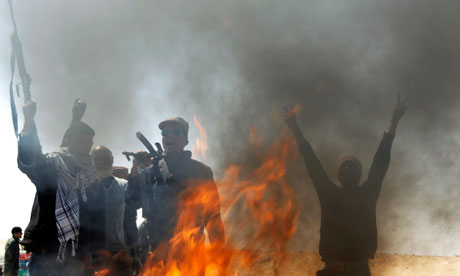
Rebel fighters burn uniforms of captured Gaddafi loyalists near Ajdabiyah

Ian Traynor and Nicholas Watt have the details of the deal. Here's a flavour.
The US, Britain, France and Turkey agreed to put the three-pronged offensive – a no-fly zone, an arms embargo, and air strikes – under a Nato command umbrella, in a climbdown by France that accommodates strong Turkish complaints about the scope and control of the campaign.
The deal appeared to end days of infighting among western allies, but needed to be blessed by all 28 Nato member states. At the end of a four-day meeting of Nato ambassadors in Brussels, Anders Fogh Rasmussen, the secretary general, said Nato had agreed to take command of the no-fly zone from the Americans. Disputes have raged at Nato HQ every day this week. Rasmussen contradicted leading western officials by announcing that Nato's authority was limited to commanding the no-fly zone, but he signalled there was more negotiation to come.
Under the scheme agreed, the transfer to Nato will take place by the latest in London on Tuesday, when the parties to the coalition against Gaddafi gather in London for a special "contact group" conference. French sources said the Benghazi-based Libyan rebel leadership would be in London to attend. The conference will consist of two meetings: a war council made up of the main governments taking part in the military action, as well as a broader assembly including Arab and African countries devoted to Libya's future.
The British defence secretary, Liam Fox, says British Tornado GR4 aircraft launched a number of guided missiles at Libyan armoured vehicles.
"The Tornado aircraft launched a number of guided Brimstone missiles at Libyan armoured vehicles which were threatening the civilian population of Ajdabiya. Brimstone is a high precision, low collateral damage weapon optimised against demanding and mobile targets," said Fox.
Mr Saleh and Gen Ahmar were intent on preventing bloodshed and preserving stability, the people familiar with the negotiations said. Aides to both men said they understood that Mr. Saleh's continued rule is untenable. But the two men also agreed that his resignation can't happen until the details of a transitional governing council that would take his place.
"Wefaq affirms the need to protect safety and lives and not to give the killers the opportunity to shed blood," it said on Thursday.
Nine demonstrations appear to be planned, across different parts of Bahrain, including one headed toward the airport and one that aims to "liberate" Salmaniya hospital. Security forces raided Salmaniya hospital in the crackdown, removing several tents set up by protesters in previous weeks. Doctors and human rights groups say strict security has hampered medical access and that four medical staff have been arrested.
"After the horrific killing of dozens of protesters last Friday, it is incredibly disturbing that Yemen's leaders have given the security forces more powers through a new emergency law instead of reining them in," said Philip Luther, Amnesty's Middle East and North Africa deputy director. "The emergency law appears to be a desperate attempt to reinforce mechanisms to stamp out dissent and shut out witnesses to human rights abuses."
Amnesty has also called for an immediate halt to the use of "excessive force" by Syrian security forces after reports that more than 100 were killed in protests in the southern city of Deraa on Wednesday. Katherine Marsh (a pseudonym) reported on public outrage over the government's brutal response in today's Guardian.
Sheik Abdullah bin Zayed Al Nahyan says the UAE committed six F-16s and six Mirage aircraft to "participate in the patrols" over Libya. His comments were published by the state-run Wam news agency on Friday. Qatar, which has sent two planes, is expected to start flying air patrols by this weekend.
Messages seeking some kind of peaceful end to UN-backed military action or a safe exit for members of Gaddafi's entourage have been sent via intermediaries in Austria, Britain and France, said Roger Tamraz, a Middle Eastern businessman with long experience conducting deals with the Libyan regime.
At the UN, envoys said Sudan had quietly granted permission to use its airspace to nations enforcing the no-fly zone. Sudan's UN ambassador, Daffa-Alla Elhag Ali Osman, neither confirmed nor denied that report.
South of the Sahara, local media quoted a cabinet minister as saying Uganda would freeze Libyan assets worth about $375m in line with a UN resolution imposing sanctions on Libya following Gaddafi's violence crackdown.
A Danish F16 fighter lands at Sigonella airbase in Italy Photograph: Filippo Monteforte/AFP/Getty Images

"We don't want power, but we need to hand power over to safe hands, not to sick, resentful or corrupt hands ... We are ready to leave power but only for safe hands," Saleh said in the speech shown on state TV, as tens of thousands of his opponents protested in another part of the capital. "We are against firing a single bullet and when we give concessions this is to ensure there is no bloodshed. We will remain steadfast and challenge them with all power we have."
"As you can see, everything is back to normal and it is over," an army major, standing in front of the ruling Baath party head office in Daraa, told journalists before they were escorted out of the city.
Live blog: email
African Union commission chairman Jean Ping said in an opening speech that the AU favours an inclusive transitional period that would lead to democratic elections. Ping stressed the inevitability of political reforms in Libya, and said that he believes a consensus can be reached. He called the aspirations of the Libyan people "legitimate."
"We are convinced that there is enough base to reach a consensus and find a durable solution in Libya," he said.
Live blog: email
Damascus's streets were quiet as this morning, as they usually are before Friday prayers. However, there is a increased sense of tension - as well as plain clothed security agents who have been a feature of the streets for the week.
Big protests have been called for today across the country. I have not yet witnessed any but half an hour ago, groups of pro-Assad supporters - a feature of the past few days - drove round Damascus waving flags and photographs of the president.
After the pledges to consider reform made by the government early yesterday evening, Syrians across the country were at home last night processing what they meant and whether it changes the game today. "I do not think it will be enough; anger rose at the killings in Deraa and these announcements - which didn't offer anything solid - may have only added to that," said one man late last night.
anti-government protesters in Karzakan, Bahrain Photograph: Hasan Jamali/AP

Ian Black Libyan government minders took a bus load of journalists to Tajura east of Tripli today where we saw a house in a rural area with a big garden. There was apparent damage caused by a missile which had landed in the garden. There were fragments of a US air-to-surface missile. A window and some furniture had been broken. According to the father, his 18-year-old daughter was injured and taken to hospital. What was difficult to understand was the link between the rocket fragments and the damage, there were also bullet holes on the wall. The general feeling was that something certainly had happened and it was an effort to underline how civilians have been victims of "colonial aggression". Surprisingly, however, we have not been taken to any hospitals. I don't doubt there have been some civilians casualties with thousands of missiles fired, but there has been no evidence of deaths to civilians on a large scale. We spent a good hour at the house but we sped by a building at a military installation that had been flattened by a missile and a radar installation on a sand dune that was completely destroyed, now a charred hulk. But there was not a word on that.
The UAE's decision to contribute 12 planes to the no fly zone operation is evidence of the real and tangible Arab role, building on the leadership the Arab League as a whole showed when they originally led calls for a no fly zone over Libya.
Live blog: email Eyewitnesses told the Guardian that around 200 anti-government protesters were dispersed from the Omyyad mosque in Damascus this morning. Similar to last week, a call for "freedom" came from someone inside the mosque which was then entered at by pro-Assad supporters and security forces. Security forces used rough treatment - beating and arresting at least two, witnesses said. Other worshippers quickly left the mosque. In Aleppo, contacts said again only 200 anti-government protesters were seen, contrary to some reports. The gathering was quickly broken up and replaced by hundreds of supporters of the president, Bashar al-Assad.
The troops started shooting on the crowds after they set fire to a bronze statue of the country's late president, according to a resident on the scene.
Tens of thousands of Syrians were taking to the streets across the country in the most widespread civil unrest in years, defying crowds of government backers and baton-wielding security forces to shout their support of the uprising in Daraa, according to witnesses, activists and footage posted online.
Thousands flooded Deraa's central Assad Square, many from nearby villages, chanting "Freedom! Freedom!" and waving Syrian flags and olive branches, a resident told The Associated Press by telephone.
Anti-government protestors shout slogans during a demonstration in Yemen Photograph: Muhammed Muheisen/AP

Helicopters buzzing overhead, extra checkpoints erected on major highways and a large troop presence prevented any major demonstration from kicking off in the small Gulf Arab island kingdom.
A few hundred protesters managed a short rally in the Shia village of Diraz, shouting "down with the regime" as women swathed in black waved Bahraini flags and held up copies of the Quran. But they fled when when around 100 riot police fired tear gas and tried to chase them down.
In the village of al-Dair, police fired rounds of tear gas to disperse around 100 protesters who had marched toward a main road next to a runway at Bahrain international airport.
Residents in nearby streets rushed women and children into their house as police continued to loose tear gas. They said police had also fired birdshot ammunition at protesters.
Meanwhile a Nato official in Brussels said planning for Nato's no-fly operation assumed a mission lasting 90 days, although this could be extended or shortened as required. France said the war could drag on for weeks.
"I doubt that it will be days," Admiral Edouard Guillaud, the head of French armed forces, told France Info radio. "I think it will be weeks. I hope it will not take months."
"Another twin set of demos have seen hundreds of thousands of anti-government protesters gather outside of the university and a similar number of pro government protesters elsewhere. The president for the first time gave a speech to protesters and reiterated his intention to give up power, but he didn't say when or to who."
Listen!
Anti-government protestors carry the bodies of Mohammed Ahmed and Mujahed Abdul Haq 

Photograph: Muhammed Muheisen/AP

A Qatar air force Mirage 2000-5 flew alongside a French Mirage 2000-5 fighter jet in a patrol Friday over Libyan airspace, the military said in a statement.
Qatar has deployed six Mirage fighters (rather than the two we mentioned earlier) and two C-17 transport jets to support the operation.
Yemen president held meetings in past 48 hours with top army general who has defected to protestersless than a minute ago via web


Al-Shurouk, Egpytian newspaper
We know that the western states are interfering in Libya only out of fear on oil supplies and to keep prices stable. The proof is to compare Libya's case to Yemen.
The two presidents are not wanted but cling to power. They both used weapons against their people. But the western states were so upset with Libya and decided to bomb Gaddafi's military targets to topple his regime while no one cares about what the Yemeni president is doing although he killed more than 50 of his people by using snipers and hand grenades.
It is very clear Libya means oil for the west, Yemen does not mean that much.


Al-Sherq al-Awssat, Saudi newspaper based in London
The US administration which did not hesitate in demanding Gaddafi's dismissal, is not ready to force him to leave through a military campaign as it did with Saddam Hussein.
Gaddafi knows that American and European public opinion are not prepared for western forces to be sent to Libya or any Arab country after the experience in Iraq and Afghanistan and he is capable with his military and money to stand up to air strikes and sanctions.
The rebels might be able to keep control of Benghazi and the eastern part of the country but they can't enter Tripoli without foreign military support or a military coup.


Al-Itihad, UAE newspaper based in Dubai
Obama hopes that Gaddafi's forces will be defeated quickly, opening the way for a political solution. The hope is that Libya will get a new president or Gaddafi will be forced to leave the country, but what will happen if this is not achieved? What will happen if Gaddafi keeps fighting and uses his money to recruit mercenaries?
Without sending infantry troops, there will be no quick end to this war. The Libyan rebels would be in charge of the mission to end the war, but the problem is we do not know who these rebels are?
Live blog: recap
US authorities say that the coalition fired 16 Tomahawk cruise missiles and flew 153 air sorties in the past 24 hours. A Nato official said that the no-fly operation is set to run for 90 days, although this could be extended or shortened. The UAE has decided to send war planes to help enforce the no-fly zone.

President Saleh of Yemen has said on national television that he is willing to hand over power, but did not specify when or to whom.
Separate demonstrations both for and against the government have been held in different parts of the city.
Syrian troops opened fire on protesters in the southern city of Deraa. Witnesses said there were several casualties. In Damascus, supporters of the Deraa protesters clashed with backers of the regime outside the historic Umayyad mosque.

Security forces in Bahrain quickly snuffed out small protests in Manama.
In the village of al-Dair, police tear gas to disperse around 100 protesters who had marched toward a main road next to a runway at Bahrain international airport.

Is New York really 'too New York' for cycling

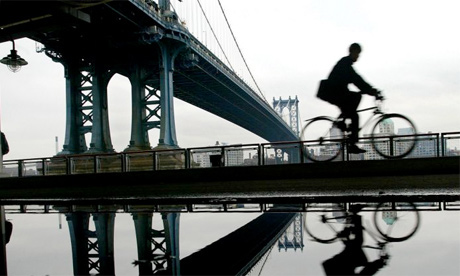
Cyclist Manhattan Bridge New York
 
A cyclist riding under the Manhattan Bridge, New York. Photograph: Shannon Stapleton/Reuters

Since I last wrote about the New York bike lanes controversy, there have been some interesting developments. Arguably, the most surprising was that a Guardian headline got a round of applause in a public meeting.
To recap quickly. Michael Bloomberg's administration has put in over 250 miles of bike lanes in New York city over the last four years, entrusting this modest but significant shift to pro-bike policy to his transportation commissioner Janette Sadik-Khan, who has also made waves with a couple of high-profile pedestrianisation projects, including Times Square. Bike use in the city is estimated to have doubled in this period, with bike lanes also showing significant safety benefits for all road users (not just cyclists).
But not everyone has bought in to the programme. And one bike lane in particular, the now world-famous Prospect Park West (PPW) bike lane, has become the focus for a concerted counter-revolutionary push. A posse of Prospect Park residents have signed up a hotshot corporate lawyer, on a pro bono basis, to sue the city for having abused its authority by installing this bike lane, alleging that it connived with the pro-bike lobby to misrepresent the need for and effectiveness of the measure.
Sniffing blood, namely Sadik-Khan's, the New York Post (a tabloid) and the New York Times have raised the temperature. And from the PPW bike lane battle, other skirmishes have broken out all over the media – including a civil war in the hallowed corridors of the New Yorker magazine, where economics writer John Cassidy aired his view that the city had been hijacked by the bike lobby in "a classic case of regulatory capture".
After an even more classic takedown by Reuters financial blogger Felix Salmon, Cassidy tried to extricate himself from the hole he'd dug by digging some more. And some more. Until the New Yorker's political writer Hendrik Hertzberg came along to bury him.
This was all good fun, and shows the depth of engagement of serious people with an issue sometimes characterised (wrongly) as trivial, but it was essentially a sideshow to the serious business of transportation policy in the city. With the lawsuit against the PPW lane under way, it was clear that a serious pushback had begun – which is what prompted me to write my last post here.
At last, though, the backlash seemed to have provoked a reaction from the supporters of bike lanes (who actually constitute a majority of New Yorkers, according to the most recent poll). A community board meeting in Brooklyn largely endorsed the PPW bike lane – which is not altogether surprising since the neighbourhood's community board had requested the bike lane from the city's transportation department in the first place, and the majority of local residents approve it.
In a typically comprehensive piece of reporting, New York magazine (not to be confused with the New Yorker) returned the focus to the PPW bike lane's larger bearing on city-wide policy – asking: "Is New York too New York for bike lanes?" This was met by a surprise move from deputy mayor Howard Wolfson, who responded with a memo (pdf) to "interested parties" robustly defending the case for bike lanes. Since then, Wolfson has also appeared on National Public Radio, on the Brian Lehrer Show, fighting the city's corner, putting out some necessary, absent facts and rebutting the criticisms of the PPW lawsuit attorney, Jim Walden, who had appeared on the same NPR show the previous day.
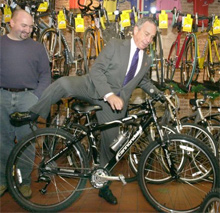
New York Mayor Michael Bloomberg on bike New York mayor, Michael Bloomberg, mounts the Cannondale mountain bike he purchased at Gotham Bikes in 2002. Photograph: AP Photo/Ed Bailey This now feels like a critical moment. Instead of appearing to wash his hands of his transportation commissioner, Mayor Bloomberg has clearly moved to back her, getting a senior executive like Wolfson out in front of the media to own the policy and speak up for it. As Aaron Naparstek (@naparstek) of the influential Streetsblog told me:
"We've never had anyone as senior in city government advocating for bikes before. It suggests City Hall is fully supportive of what Janette Sadik-Khan is doing. And that's great … Given there's now a clear message from the top of the administration, I'd expect that will cool things down in the press."
So, is that the happy ending to the saga?
Hardly. For one thing, there is the lawsuit, which will be heard in Brooklyn's Kings County supreme court. On the face of it, there is no case to answer: the department of transportation followed procedure, answered a call from the community board, conducted a survey, delivered the results; the community board voted approval and the bike lane was built. But Walden is subpoenaing everyone's email records in an effort to make his charge of collusion between bike advocates and city officials stand up. With a sympathetic press and possibly a sympathetic judge, what appears a threadbare strategy might make headway. And even if the lawsuit runs into the sand, its backers will continue to carry the fight into the realm of symbolic politics.
And then, though apparently unrelated, there is the New York Police Department (NYPD) ticketing blitz against cyclists. I already reported the beginning of this campaign, which seems to have consisted largely of squad cars observing cyclists riding recreationally around Central Park when the roads are closed to traffic and then handing them $270 fines for going through red lights which, by custom and convention (and possibly by law), only apply when the roads are open to vehicles. But the latest phase in this bizarre approach to enforcement has been truly surreal. On Tuesday morning, NYPD officers used a radar gun to catch cyclists "speeding" in the park, and handed out 10 tickets. Questions were bound to be raised as to whether this constituted a useful deployment of police resources and justifiable expenditure of taxpayer dollars, but the NYPD's embarrassment was complete when it turned out they'd enforced the wrong speed limit, which is 25mph for cyclists, not 15mph. Officers have now made house calls to cancel the tickets and apologise.
Yet the red light ticketing looks set to continue. I attended a public meeting in on Central Park West where Captain Wishnia, the officer responsible for the enforcement, debated the policy with an audience of about 300 concerned residents, park users and cyclists. It was evident that he was acting on instructions from above, though it was not clear whether these came from City Hall itself, or from the upper echelons of the NYPD. For a somewhat beleaguered biking community, it would be tempting to see some connection between the bike lane backlash and the cops' "get tough" policy. But the likelihood is that the two issues have merely coincided, and are not part of a generalised persecution of cyclists.
If there is a link, it is that both affairs have a "culture wars" dimension as New York adjusts to a new idea of itself and of cycling's role in the life of the city. Naparstek says of the NYPD: "They tend to have a deep 'windshield' perspective on the city. Many now live outside the city, in the suburbs, and drive in to work. Culturally, they don't seem to get why anyone would cycle in the city." Worse, since the bitter confrontation at the 2004 Republican national convention in New York, where hundreds of Critical Mass cyclists were arrested and manhandled, the NYPD's rank and file tends to see cyclists "as a force for disorder and chaos".
The irony of the crackdown, Naparstek observes, is that "a lot of people in the bike advocacy community would support real enforcement" on city streets, as opposed to in Central Park. The problem, he says, is that the NYPD simply doesn't know how to do it. So, instead of real enforcement that would actually encourage compliance, there is this "completely bogus ticketing blitz, where the only metric of success is the number of tickets written". And the easiest way to catch a large number of cyclists with a small number of personnel is to go to the park. Naparstek believes the best way forward is for bike advocates, like Transportation Alternatives, to sit down with the NYPD and work on enforcement and compliance together. But that will take a culture shift on both sides.
Can it be done, or is New York really "too New York" for cycling ever to be acceptably mainstream?
That remains to be seen – and I'm optimistic – but what has become painfully obvious is that putting in place the infrastructure, the bike lanes and paint on the road, is the easy part. Changing perceptions and altering the way people think about cycling and cyclists is the uphill bit.

Chard remains

chard
 
Brillant Bright Lights chard and bull's blood

Warm wet weekend, the sort you where you'd have read Kidnapped as a kid while staring out the window at the sheeting rain while, hopefully, your mother bakes a cake or makes jam.
Hadn't been at the plot for a fortnight as it's been impossible to get there before dark after work. And time is running out. Have tares, clover and field beans for green manure (some should be in by now). But also need to dig in the cow muck which, tell the truth, could do with another turn.
beans The borlotti bean harvest Trouble is the part of the plot we are planning to 'rest' is still stubornly churning out delicious chard (had some last night with Simon Hopkinson's amazing Asian style pork belly) and winter salad leaves.
leaf  
Autumn salad leaf That and the fact Howard is away again means I am sort of coasting at the moment, tidying up and watching the tagetes fade, the fennels seed, and the calendula hint at mould.
Something in me loves this time of year (while sort of hating it, too). The owl calls mid afternoon, the fox makes an appearance, the day gets darker and colder. But working on your own while the wet mist descends feels like therapy.
chard 
Swiss chard for fast steaming with Asian-style pork belly Anyway Howard back from Italy today, with yet more chicory seeds he says. So perhaps next weekend we will get more done before the working party and the harvest barbecue. So any plans progressing where you are, any seed to sow, crops to cut, flowers to stand back and admire?

Golden showers

beech
 
Autumn at the allotment gate

Quick trip to the plot for leaves for lunch. The cooking greens are all gone except for transplanted and seedling kale, but there is still salad and herbs to tide us over.
onion  
Radar onion showing signs of life No one else there in the rain, but something wonderful about watching the golden leaves swirl around in the wet wind on your own.
hip 
Rose hips on the path to the plot No sign yet of the new growth under the poly-tunnel, maybe we really were too late? Will watch and wish anyway.
gold 
Last of the golden rasberries But lots of new shoots from the green manure making its presense felt in the muck. Too early to say for sure, but suspect it's the clover (though maybe the tares?). Either way it warmed me in the wet to see so many signs of fresh life.
leaf  
Gorgeous leaves on Geoffrey's currant bush Picked chicory, red salad bowl, chervil, mizuna and sorrel and walked home via the French Market at Belsize Park to pick up cheese for superior sandwiches. Got home soaked but satisfied.
leaf 
Salad bunch for lunch Time to start planning winter chores with Howard when he is back (today, I think), but what winter work are you all doing? Any plans for new planting and what are your favourite seed catalogues (mine are piling up by the bed)? Oh, and happy belated Halloween, by the way. First of November, already, who would have thought...

Green peace and green manure

green
 
Tares and clover coming through (though admittedly some might be mustard?)

New life on the old year's allotment. With tares (I think, unless anyone knows better?) thrumming through to add the clover (again, an educated guess) in the 'resting' part of the plot. Our peas, mustard and field beans are still to make an appearance.
Signs of new life, too, under the baby polytunnel with (late) winter salads and Oriental seedlings showing thorough, though this week's deep cold snap will not help them any.
Otherwise, we are still making the transition to plot-sleeping mode with not much to do except pick through the mizuna and chicory and stand around 'communing' – for which read soaking up the wet and cold while somehow saying a quiet hello – kind of like visiting someone who doesn't talk a great deal, perhaps in a Buddhist retreat.
orientals  
New Orientals under the polytunnel Next job is to deal with Mary's walkway and stop the wood becoming too slippery. Howard is of to buy chicken wire while I ponder why I am still so keen to sow over-wintering broad beans... But now how are your gardens growing and slowing?

Daisies, daisies

daisy
 
Guerilla-gardened 'everlasting daisy' on the canal

Uplifting walk into the low winter sun this morning. Dazzling reflections the full length of the long water on the Regents Canal into the Observer office in Kings Cross. Almost spiritual, like Eliasson at the Tate.
daisy
Enhancing my pleasure, the small splashes of guerilla gardening by the inhabitants of one of the narrow boats: with lots of daisies, cooking herbs and cabbages. Another of the boats is offering 'faerie tail' readings? I have sometimes wondered about stopping off in the morning or popping in later for afternoon tea with 'tails'.
swan
Another heartwarming
pleasure comes from the sight of the large, still-fluffy cignet, born to last year's spinster swan whose mate flew away when their eggs failed to hatch. For a while she swam solo, circling her abandoned nest, even when he later returned with another female. This year, though she finally has her baby and another male, and it makes me oddly happy.
So, any good guerilla gardening near you? What is making you happy this sunny cold weekend? And any plans for gardening in the snow?

New addition to the allotment family

tara
 
Grandad with baby Tara Alexandra

Another no-gardening weekend, and not just the fault of the deep freeze this time. I have one good reason and one much less so. I think we had better start with the bad... Dear reader, I was too self-inflicted sick to even swing by the plot to say hello. You see, I had an indulgent day on Saturday with a favourite friend, the peerless cook and food writer Simon Hopkinson, which ended with many glasses of pear grappa (I know!), with a hangover the next (very early) morning I spent many hours convinced I wouldn't survive.
heron Frozen heron on this morning's frozen walk on the frozen canal But miraculously I am here now, almost healed, so let's get to the good reason: I would like to introduce Tara, my granddaughter and son Jaime's first child.
log  
Natural ice sculpture Now I won't pretend that yesterday I was in a correct state to properly greet her – at one point her week-old movements looked more elegant than mine, but holding her almost melted my hangover (the rest solved by daughter Kala popping by to cook soup, and a couple hours' sleep).
Swan  
Clearing a channel like a Russian ice-cutter (breaking ice sounding like Phillip Glass) The other small kids are getting too old to spend much time at the allotment without being bribed (though Howard's Nancy and Rose still come a lot), so give it a couple years and a packet of sunflower seeds and we may yet have a new recruit. Now I hope your weekend was healthier than mine?

Give the peas a chance

pea
 

Forage pea surviving and thriving (for now)

Carnage at the allotment. The kale, already collapsed from the cold has been hammered by the pigeons. Like gardening armageddon. Double trench warfare.


garlic
My heart fell when I first saw the plot after two weeks away. Field beans blackened by the frost. Salad bowl lettuce giving up the ghost. Even the chicory is less like the fields of Treviso than something sadder flattened by the freeze. The baby kale's been ravaged by the hungry birds. But I breathe in and slowly adjust my eyesight to the small, delicate signs of life.
kale
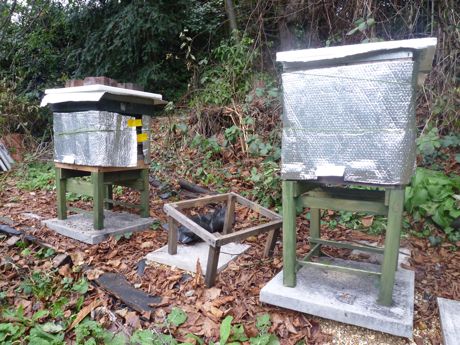
And there is some. The garlic is growing bravely in ice-solid soil. The forage peas are flying the flag for the green manure. The onions are ever so slightly inching up. The bees are still buzzing around their newly wrapped hives. It was all sort of like finding friends alive on a battlefield.
hives
So I got out the scrubbing brush to clear the path before Howard arrived with wire and tools to get some work done. But I will let him tell you about that later... So, in spite of the ice, there are signs of hope and brave new life on the allotment.
Bow with just a week to go till the winter solstice, how are you and your gardens holding up? With love and warm hugs from London....